AI & Materials Discovery
Machine learning, generative AI and data-driven approaches for discovering and designing new materials.
ELECTRONS TO MATERIALS (E2M) GROUP
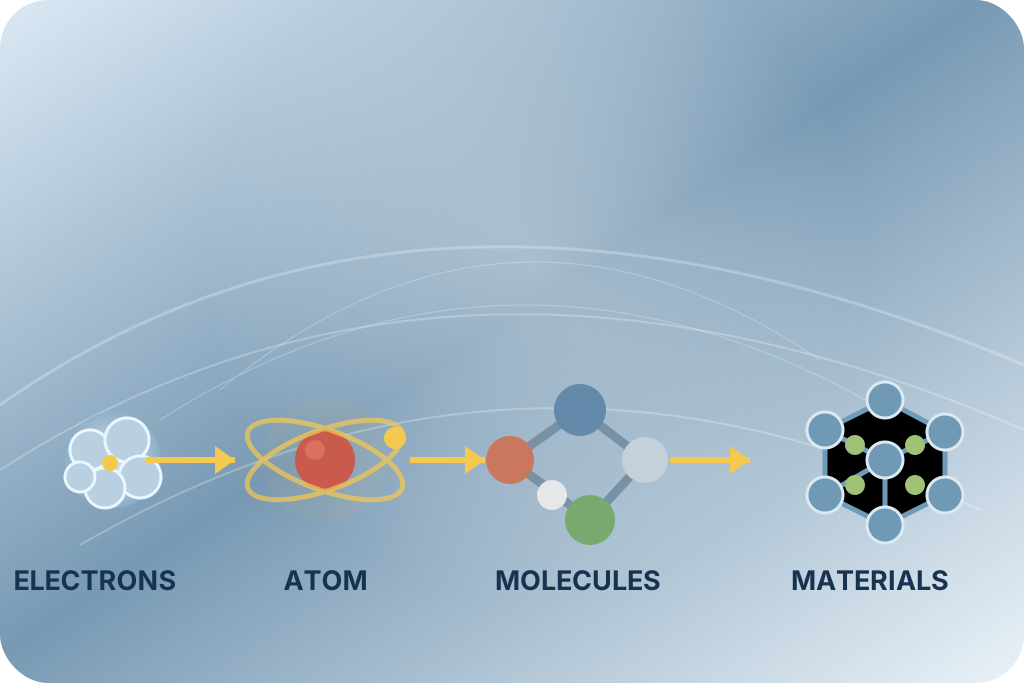
We develop computational methods that connect quantum mechanics, atomistic simulation and machine learning to accelerate materials discovery and understand complex materials.
01 / ABOUT THE GROUP
The Electrons to Materials (E2M) Group works at the intersection of computational materials science, atomistic simulation and artificial intelligence.
We develop and apply density functional theory, molecular dynamics, machine-learning force fields and data-driven methods to understand materials and accelerate their discovery.
Our research spans energy-storage materials, polymer nanocomposites, electrochemical interfaces, ion transport and emerging quantum–classical approaches for materials simulation.
02 / RESEARCH
Developing computational approaches for materials that matter — from batteries and interfaces to advanced polymers and AI-enabled discovery.
Machine learning, generative AI and data-driven approaches for discovering and designing new materials.
ML interatomic potentials for simulations beyond the length and time scales accessible to conventional first-principles methods.
DFT, hybrid functionals, GW, TDDFT and related atomistic approaches for understanding structure, bonding, electronic and optical properties.
Computational studies of lithium/sodium batteries, solid-state electrolytes, ion transport and materials degradation.
Atomistic modeling of electrode–electrolyte interfaces, electrosorption, electrodeposition and electrochemical reactions.
Molecular simulation of polymer nanocomposites and structure–property relationships for advanced engineering applications.
03 / EXPERIENCE
School of Mechanical Engineering · Vellore Institute of Technology, Vellore, India
University of Warwick, UK · Dr. Bora Karasulu's group
Microvast, Florida, USA
Idaho National Laboratory, Idaho, USA
Michigan Technological University, Michigan, USA · Dr. Gregory Odegard's group
04 / PUBLICATIONS
Selected peer-reviewed work spanning energy materials, electrochemistry, atomistic simulation and advanced composites.
Gaikwad, P. S.; Chakraborty, T.; Fitkin, A.; Whalley, P.; Karasulu, B.
View paper ↗Gaikwad, P.; Sener, S.; Karasulu, B.
View preprint ↗Hossain, J.; Gaikwad, P.; Yun, S.; Schulze, J.; Penrod, K.; Pawar, G.; Li, M.; Lin, Y.; van Duin, A.
View paper ↗Gaikwad, P. S.; Mondal, K.; van Duin, A.; Yun, S.; Pawar, G.
View paper ↗Gaikwad, P. S.; Pawar, G.; Yun, S.; Hossain, J.; van Duin, A.
Odegard, G. M.; Patil, S. U.; Gaikwad, P. S.; Deshpande, A. S.; Krieg, S. P.; Shah, S. P.; Reyes, A.; Dickens, T.; King, J. A.; Maiaru, M.
Gaikwad, P. S.; Kowalik, M.; Jensen, B. D.; van Duin, A.; Odegard, G. M.
View paper ↗Gaikwad, P. S.; Kowalik, M.; van Duin, A.; Odegard, G. M.
View paper ↗Gaikwad, P. S.; Krieg, A. S.; Deshpande, P. P.; Patil, S. U.; King, J. A.; Maiaru, M.; Odegard, G. M.
View paper ↗Bamane, S. S.; Gaikwad, P. S.; Radue, M. S.; Gowtham, S.; Odegard, G. M.
Deshpande, P. P.; Radue, M. S.; Gaikwad, P.; Bamane, S.; Patil, S. U.; Pisani, W. A.; Odegard, G. M.
05 / TEACHING
We teach and mentor students at the intersection of mechanical engineering, computational science and artificial intelligence.
06 / CONTACT
We are open to research collaborations, student interactions and discussions at the intersection of computational materials science, AI and energy materials.
Dr. Prashik Gaikwad
School of Mechanical Engineering
Vellore Institute of Technology
Vellore, Tamil Nadu, India